One customer, many channels: see their whole history in one chat
Stop making customers repeat themselves every time they switch from Facebook to WhatsApp.
Read inBahasa Melayu中文
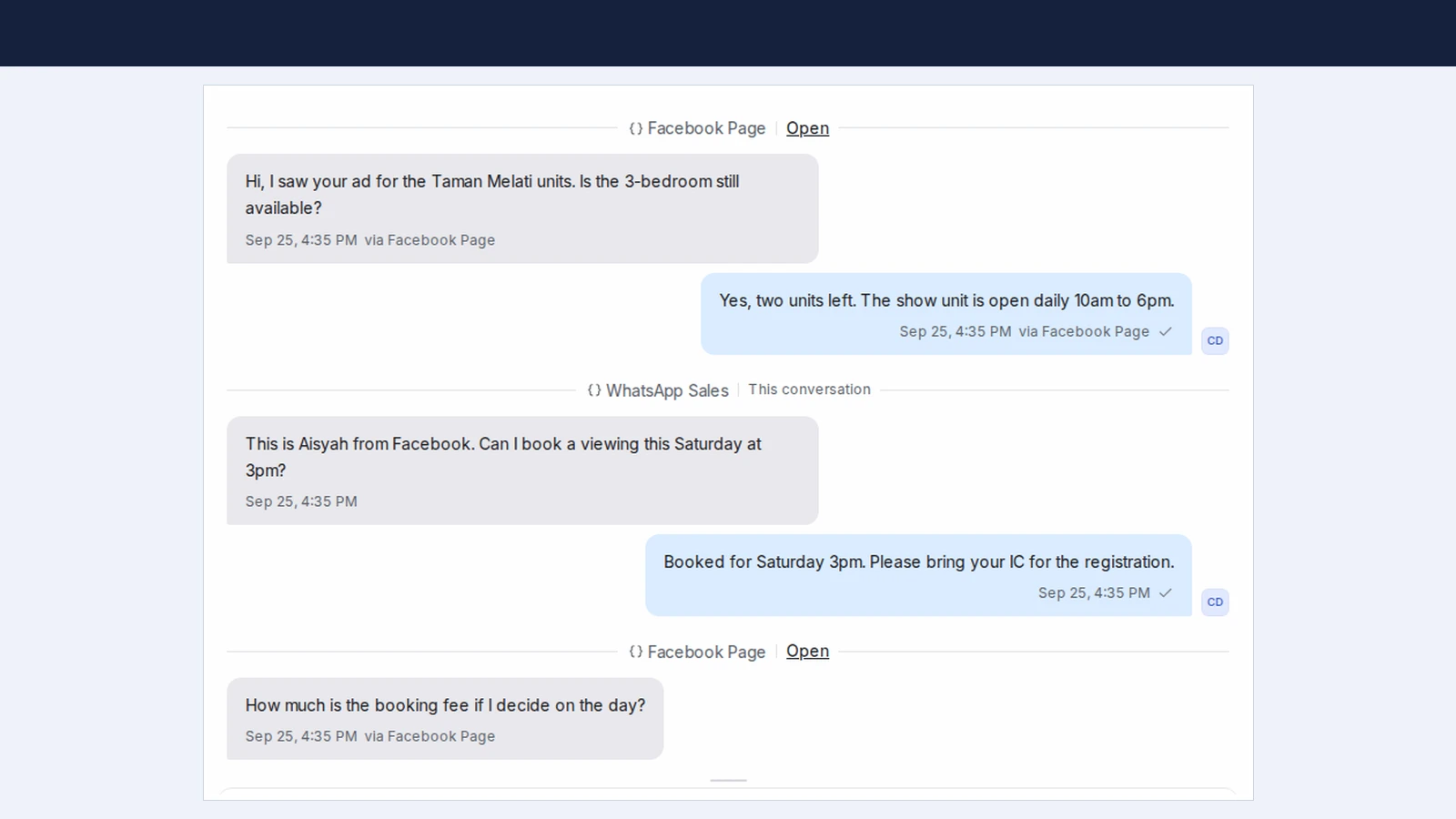
Your team keeps asking the same questions because every channel keeps its own chat. When one customer writes on WhatsApp, Facebook and Instagram, that is three separate conversations, often answered by three different people. The fix is to group conversations by customer, show them in one timeline, and let staff and chatbot read what was already said.
Why does one customer end up in three separate chats?
Malaysians don't pick one channel and stay on it. In early 2025, Facebook's advertising reach in Malaysia covered about 66% of internet users, TikTok about 55% and Instagram about 44%, and WhatsApp is the messaging app almost everyone has open all day. The same person sees your ad on Instagram, asks a quick question in the DM, then moves to WhatsApp when it gets serious, because that is where they keep every other conversation in their life.
On your side, each of those channels arrives as its own inbox. A Facebook Page conversation belongs to a Facebook profile with a display name. An Instagram DM belongs to an Instagram handle. A WhatsApp chat belongs to a phone number. None of them carries the others' identity, so the tools that receive them, including Meta's own Business Suite, treat them as three different people until someone links them by hand.
Then the shift changes. The person who answered the Facebook question on Monday is off on Tuesday, and the colleague who picks up the WhatsApp message has never seen it. To them it is a new enquiry, so they start from the beginning: "Hi, may I know which model you're interested in?"
What does it cost you when your team can't see the whole history?
The customer feels it first. Being asked for details you gave yesterday reads as "they don't remember me", and for an expensive purchase, a car, a renovation, a course, that is the moment a buyer starts comparing you with someone else. A business that answers on many channels is only as good as the one that is worst informed.
It costs your team as well:
- Time spent re-collecting. Name, area, model, budget, preferred date: five questions that were already answered, asked again in every new chat.
- Double follow-ups. Two staff chase the same lead on two channels, sometimes with different prices.
- Lost context on handover. A customer who says "as I said before" on WhatsApp is referring to a Facebook chat the agent cannot see.
- A chatbot that behaves like a stranger. If your chatbot collects details on Instagram and then meets the same person on WhatsApp, it asks everything again unless it can see the earlier answers.
Meta's own figure gives a sense of the scale: as of May 2022, one billion people message with a business each week across WhatsApp, Messenger and Instagram. A share of those people will message the same business on more than one of them.
How do you see one customer's chats from every channel in one place?
Whatever tools you use, the same four things have to be true.
- All channels land in one place. If WhatsApp is on a phone, Facebook is in Business Suite and Instagram is in the app, no amount of discipline joins them. Bring every channel into one team inbox first.
- Conversations are grouped by customer, not by channel. One contact record per person, with their WhatsApp number, Facebook profile and Instagram handle attached to it. Every conversation on any channel hangs off that record.
- The history is one timeline. A list of past conversations helps, but what an agent needs while replying is to read the Facebook question of 9:02 directly above the WhatsApp message of 9:05, in the order the customer sent them, without opening anything else.
- Linking identities is a deliberate act. A customer typing a phone number into a Facebook chat is not proof it is their number; anyone can type someone else's. If a tool linked profiles automatically on a typed number, one wrong or mischievous message could attach a stranger's WhatsApp history to that profile. Detect and suggest, then let a person confirm.
You can approximate the first two with a spreadsheet and a strict naming rule, and some teams do. It breaks the first time someone forgets, and it never gives you the timeline.
Should every conversation always be shared?
No. There are cases where seeing everything is wrong:
- Two brands or projects on separate numbers. A property developer running two launches from two WhatsApp numbers doesn't want a buyer's questions about one project shown inside the other. The same goes for a group with a clinic and a pharmacy line.
- One conversation that should stay private. A complaint, an HR matter, a payment dispute that the rest of the team shouldn't scroll into.
- A chatbot that shouldn't reuse an answer. Details collected for one project (a budget, an address) may be wrong for the next.
So the rule you want is "shared by default, with a switch per number and a switch per conversation", not "always merged" and not "never merged".
How does Mampu AI show one customer's history across channels?
Mampu AI brings your WhatsApp, Facebook, Instagram and TikTok inboxes into one place, keeps one contact per customer, and shows their other conversations inside the one you have open:
- One timeline. The customer's messages from their other conversations appear between dividers that name the inbox they came through, in time order with the current chat. Scroll up to load older messages from all of them. To reply in another conversation, click Open on its divider; the reply box always sends to the conversation you have open.
- Your flow agent already knows. The chatbot sees what the customer told you in earlier conversations on any channel. On a question step with Confirm a value the customer gave before turned on, it shows that earlier answer for the customer to confirm or correct instead of asking from scratch, and its handover note tells your team which other channels the customer has used.
- A switch per number. For a separate project or brand, turn off Share history across inboxes on that inbox's settings. Its conversations show only their own messages, stay out of your other inboxes, and its flow agent doesn't reuse answers from elsewhere.
- A switch per conversation. Open the ⋮ menu and choose Keep history separate; Share history again undoes it. Your teammates see the change immediately, even with the conversation open.
- Merging stays in your hands. When the same person shows up as a Facebook profile and a WhatsApp number, you merge them on the contact's Merge tab. Nothing is joined automatically on a typed phone number.
The problem is common enough to be worth the switches. Across Mampu AI's own Facebook, Instagram and TikTok conversations in September 2026, about 15% contained a phone number the customer typed themselves, and roughly one in ten of those numbers already belonged to a WhatsApp contact in the same account, which is exactly the "same person, two contacts" case above.
The help centre article Seeing a customer's history across channels walks through each of these with screenshots.
Frequently asked questions
Sources
Every rule and figure on this page is dated and linked to its source. Mampu AI figures are anonymised percentages across customers on Mampu AI.
Platform figures checked: 25 September 2026
Public sources
- Meta, "Announcing New Products to Make Business Messaging Easier" (19 May 2022)https://about.fb.com/news/2022/05/announcing-new-products-to-make-business-messaging-easier/
- DataReportal, "Digital 2025: Malaysia" (February 2025)https://datareportal.com/reports/digital-2025-malaysia
- Mampu AI Help Centre, "Seeing a customer's history across channels"https://help.mampuai.com/conversations/customer-history-across-channels
Give your team one history per customer
Message our team. We'll connect your WhatsApp, Facebook, Instagram and TikTok inboxes and show you how one customer's chats read as one conversation.