Too many WhatsApp enquiries after office hours? Let an AI agent reply for you.
What a good after-hours reply does, what it must hand to your team, and how to set it up.
Read inBahasa Melayu中文
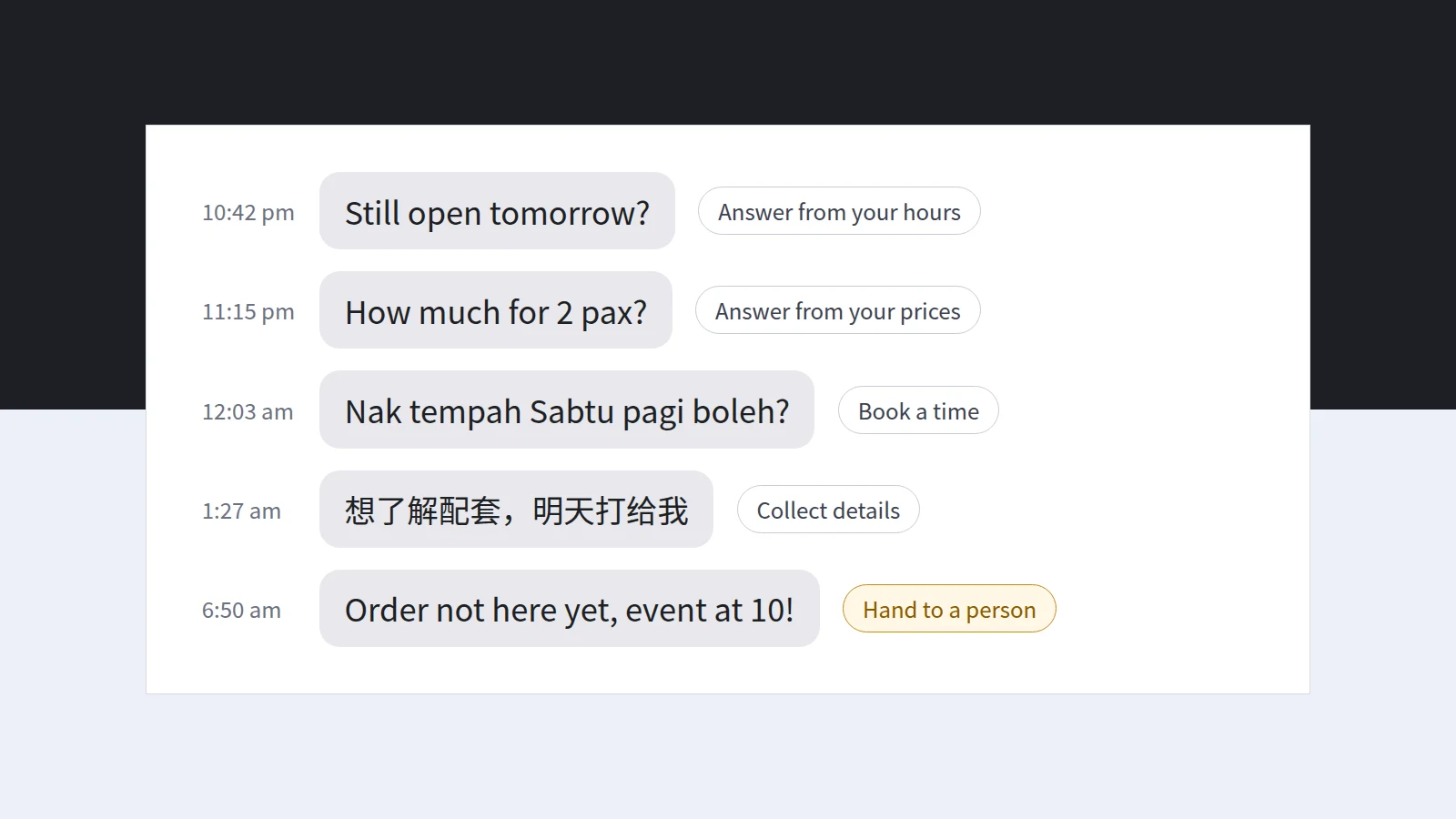
Connect an AI agent to your WhatsApp Business number. It replies within seconds at any hour, answers from your own prices and FAQs, collects details, books a time or says when your team will reply, and hands urgent chats to a person. Mampu AI, a Malaysian platform you can start free, does this. Test with real after-hours messages first.
Why do so many WhatsApp enquiries arrive after office hours?
Because that is when your customers are free. Most people can't message a shop, a clinic or an agent during their own working day, so they do it on the train home, after dinner, or in bed. Weekends are the same: the customer has time, your team doesn't.
Mampu AI's own data shows how big this is. In a one-week sample of customer conversations on Mampu AI (1 to 7 September 2026), 47.9% of customer messages arrived outside Monday to Friday, 9 am to 6 pm, and 22.3% arrived on the weekend. For a typical Malaysian business, that is close to half of all enquiries landing when nobody is at the desk.
So "too many enquiries after hours" is usually not a sign that something is wrong. It is a sign that your customers behave normally. The question is what happens to those messages until morning.
What does a slow reply after office hours cost you?
A customer who asks "how much?" at 10 pm is usually asking several businesses at once. The first one to answer properly has the best chance of getting the sale.
People expect that speed. In HubSpot's research, 82% of people rated an immediate response as important or very important when they had a marketing or sales question, and 90% when they had a customer service question. HubSpot defines "immediate" as 10 minutes or less.
After hours, few businesses get near that. In the same Mampu AI sample, when a conversation started after hours, customers waited a median of 13 minutes for a person, and 44.5% waited more than an hour. By the time someone replies the next morning, many have bought elsewhere or simply stopped replying. Our guide on why WhatsApp leads go cold shows how to read those silent chats and what to fix first.
There is also a cost on the team side. Staff who answer from their phone at midnight burn out, and the morning starts with a pile of chats that all need reading before anyone can reply.
Isn't a WhatsApp away message enough?
An away message is better than silence, but it only tells the customer you are closed. It doesn't answer the question they asked. The customer still has to wait until morning to learn the price, the opening hours or whether you have their size, which is exactly the wait that loses the sale.
A fixed away message also treats every chat the same. "We are closed, we will reply tomorrow" is fine for a price question and wrong for a customer whose order has not arrived or who says it is urgent.
What should an after-hours AI reply actually do?
The general fix is the same whichever tool you choose. A good after-hours reply should:
- Reply at once, and be honest that the office is closed. The first message should answer or move the chat forward, and say when a person will be back, for example "Our team is back at 9 am, but I can help with prices and bookings now."
- Answer from your own information. Prices, packages, opening hours, branch addresses, delivery areas and policies should come from what your business wrote, never from the AI's general knowledge. When the answer isn't there, it should say a person will follow up rather than guess.
- Collect the details your team needs. Name, what they want, which branch or area, and a good time to call, gathered in a normal back-and-forth so the morning shift can act without asking again.
- Book a time or promise one. If your business takes appointments, offer real free slots. If it doesn't, tell the customer when your team will reply and keep that promise.
- Hand urgent chats to a person. Complaints, emergencies and anyone asking for a human should go straight to your team, with the full conversation attached.
- Keep follow-ups out of the night. A reminder to a customer who went quiet should wait for a sensible hour, not land at 2 am.
Which after-hours messages should still go to a person?
Some chats should never stay with the bot, whatever the time. Set the AI to hand over when a customer:
- Asks for a person, in any words: "can I talk to someone?", "nak cakap dengan orang".
- Says it is urgent, or describes a problem that can't wait: a missing delivery for an event, a burst pipe, an injured pet.
- Complains or is upset. An angry customer who gets a cheerful bot reply at midnight gets angrier.
- Asks something your information doesn't cover, such as a custom quote or an exception to your policy.
This is also a WhatsApp rule, not just good manners. WhatsApp's Business Messaging Policy (last updated 23 September 2026) says businesses may use automation when responding in the 24-hour window "but must also have available prompt, clear, and direct escalation paths", and lists in-chat transfer to a human agent first.
Handing over is only half the job. Decide who receives the handed-over chats at night, and make sure someone reads them first thing in the morning. Our guide on customers waiting after a chatbot handoff covers how to make sure none of them are forgotten.
How do you set up after-hours replies without annoying customers?
- Set your real business hours, with the timezone. Everything else depends on the bot knowing when you are open. If you run several numbers or branches with different hours, set each one.
- Write the after-hours greeting yourself. Say you are closed, say when the team is back, and offer what the bot can do now. Keep it to two or three short lines.
- Give the AI your answers. Start with the 20 questions your team answers most, with today's prices. If you already have years of WhatsApp chats, our guide on building a chatbot from the chats you already have shows how to turn them into FAQs.
- Choose the details to collect. Only what the morning shift needs to act, asked one at a time.
- Set the handover rules and who receives them. Use the list above, and name the person or team.
- Set quiet hours for follow-ups. No automated reminders late at night or early in the morning.
- Reply the next morning within the 24-hour window. Under WhatsApp's policy, once 24 hours have passed since the customer's last message, a business can only send approved message templates. A chat left until the next afternoon may be past that point.
- Test with your real after-hours messages. Send the short, misspelt, mixed-language messages your customers actually write, at a time outside your hours, and read every reply.
How does Mampu AI reply to WhatsApp enquiries after office hours?
Mampu AI's flow agents answer customers on WhatsApp and your other channels at any hour, and you build one by describing your business in a chat, with no coding. For after-hours enquiries, they:
- Reply in seconds, at any hour, in the customer's language, from the FAQs, products and business information you give them.
- Say when your team will reply. Outside business hours your greeting and hand-over messages switch to an after-hours version, set per inbox with its own hours and timezone.
- Only offer times you can serve. A customer who asks for a time you are closed is told that day's hours and asked for another.
- Collect the details first, such as a phone number or a good time to call back, then pass the chat to the right person or team. Anyone who asks for a human is handed over at once.
- Stay quiet at night. Follow-ups that fall inside your quiet hours wait until they end.
- Can be tested before you go live. The Playground plays a chat at a pretend after-hours time, so you see exactly what customers will get.
The help guide shows where each setting lives. There is no coding and no setup fee, and you can start free. See the pricing page for current plans.
Frequently asked questions
Sources
Every rule and figure on this page is dated and linked to its source. Mampu AI figures are anonymised percentages across customers on Mampu AI.
Rules and figures checked: 13 November 2026
Public sources
- WhatsApp Business Messaging Policy (last updated 23 September 2026, read 13 Nov 2026)https://whatsappbusiness.com/policy/
- HubSpot, "Live Chat Exposes a Fatal Flaw in Your Go-to-Market" (updated March 2025)https://blog.hubspot.com/sales/live-chat-go-to-market-flaw
- Mampu AI, What is an AI chatbot (one-week conversation sample, 1 to 7 September 2026)https://mampuai.com/ai-chatbot
- Mampu AI Help Center, Building the conversation flowhttps://help.mampuai.com/flow-agents/building-the-conversation-flow
- Mampu AI Help Center, Testing and connecting an agenthttps://help.mampuai.com/flow-agents/testing-and-connecting-an-agent
See an AI agent answer your after-hours WhatsApp enquiries
Send our team a few messages your customers wrote after you closed. We'll show you an AI agent answering them, collecting the details and telling the customer when your team replies.